


The digital age has changed the way we do everyday work — from payments to paperwork.
One such change is the identity verification process through e-KYC for financial services use.
Earlier, the process of opening a bank account or applying for a loan required people to submit multiple documents physically or via courier which resulted in a waiting period of several days. The introduction of e-KYC has transformed the entire process into a faster and simple operation which requires no paperwork.
Let’s understand what e-KYC is, how it works, and who can use it.
What is e-KYC?
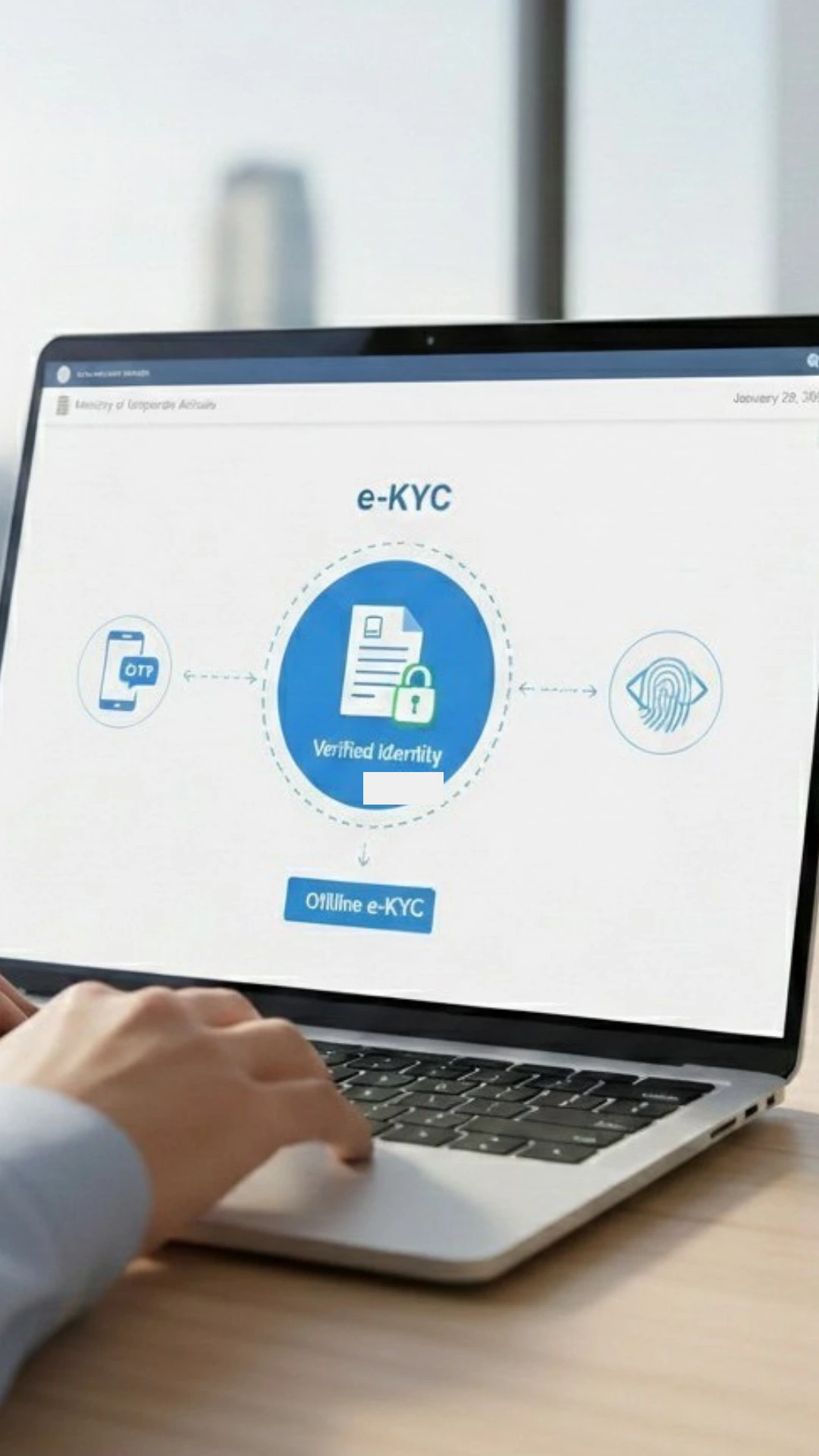
e-KYC stands for Electronic Know Your Customer.
It is a digital method of verifying your identity using your Aadhaar number. Instead of submitting physical documents, your identity is confirmed online through secure systems linked to Aadhaar.
e-KYC enables banks, NBFCs and financial institutions to confirm your identity through a fast and secure process that requires no physical documents.
The system is provided by UIDAI and has received an official approval from RBI for use in financial transactions.
Why e-KYC is Important
e-KYC is not just about convenience — it improves safety and speed in financial services.
Some key benefits are:
- Faster processing: Your identity is verified within minutes
- Paperless: No need to submit multiple photocopies
- More secure: The system decreases the possibility of fake or forged documents
- Cost-effective: The process is cost-effective and time efficient for customers and lenders
- Easy access: Enables first-time borrowers to access financial services
Types of e-KYC in India
There are different ways e-KYC can be done, depending on the method used for verification:
1. OTP-based e-KYC
In this method, you enter your Aadhaar number and receive an OTP on your registered mobile number. After entering the OTP, your identity is verified.
This is the most commonly used and easiest method.
2. Biometric-based e-KYC
Here, your Aadhaar is verified using fingerprints or iris scan. This method is used where higher security is required.
It is mostly done at physical centres or assisted service points.
3. Offline e-KYC
In this method, you download a digitally signed file from the Aadhaar website and share it wherever KYC is needed.
This helps protect your Aadhaar number and gives you better control over your data.
Who is Eligible for e-KYC?
You can use e-KYC if:
- You are an Indian resident with a valid Aadhaar number
- Your Aadhaar is linked to your mobile number
NRIs and foreigners who have lived in India for at least 182 days in the past year and have Aadhaar are also eligible.
What Documents Are Required for e-KYC?
Since e-KYC is a digital process, no physical documents are needed.
Usually, you only need:
- Aadhaar number
- Mobile number linked to Aadhaar
- In some cases, a passport-size photograph
That’s it — no long document lists or repeated submissions.
How to Do e-KYC Online: Step-by-Step
Here is a simple way to complete your e-KYC:
- Visit the website of a registered KYC agency or financial institution
- Enter your Aadhaar number and mobile number
- Receive and enter OTP for verification
- Confirm your details
- Submit and complete the process
Once done, your e-KYC is completed digitally.
How to Check Your e-KYC Status
To check whether your e-KYC is complete:
- Visit the CDSL or KRA website
- Click on “Check KYC Status”
- Enter your PAN or Aadhaar number
- Submit and view your status
If verified, your status will show as completed. If not, it will show pending.
e-KYC has made financial services easier, faster, and more transparent. For business owners, this means quicker access to loans, accounts, and other services without running around for documents.
Understanding e-KYC helps you save time and avoid unnecessary delays in your financial journey.
At Arka Fincap, we use digital processes like e-KYC to ensure faster, smoother, and hassle-free services for our customers — so you can focus on growing your business, not paperwork.
Arka Fincap — Aapka Apna Financial Partner.

The mark ‘Kirloskar’ in the status line is owned by Kirloskar Proprietary Limited and Arka Fincap Limited is the permitted user